Claude, Investigation Query.
The investigation-query skill has Claude search an investigation log the same way every time using a written checklist, which produces consistent search results but no ability to judge what actually happened or who is telling the truth.
Claude picks up a skill called investigation-query. Does that mean it can now work out what really happened, cross-referencing witness accounts and judging who is telling the truth? No. It searches an investigation log the same way every time. Nothing about Claude's underlying judgment changes; what it gets is a fixed search routine.
Proof by deletion
Delete the skill folder and Claude loses no ability to judge who is telling the truth, because it never had that ability. It just stops running one search routine. That distinction is the cleanest way to see what this skill, and skills generally, actually are: a specification for a repeatable process, not a new form of judgment Claude has acquired.
What's actually inside the file
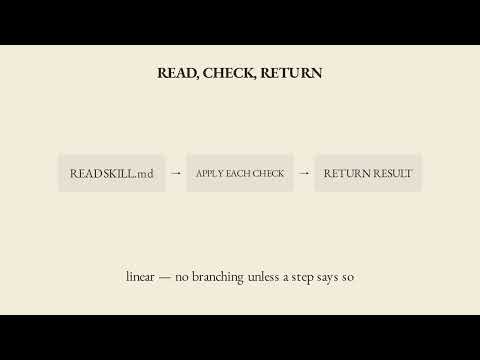
Investigation-query is a folder holding a single SKILL.md file with instructions for searching an open investigation log, answering questions like what a given witness said, written in plain language Claude reads before it starts. Claude reads the file top to bottom and works through it step by step in the order written, with no branching unless the file itself says to branch. That makes it a specification, not judgment: the payoff is the same search on every question, every time; the limit is that anything outside those written steps gets no special treatment.
What the routine actually guarantees
Investigation-query never gives Claude the power to judge what a witness meant. What it guarantees is that every time it runs, Claude reads the same file and searches the log the same way. That consistency is the entire trick, and it matters because a search process that varies from run to run would make the results unreliable to compare or rely on later.
Why a found answer or an empty result isn't proof
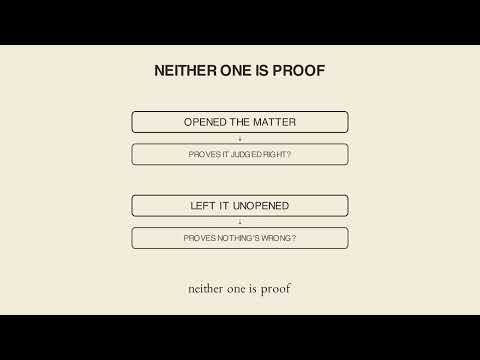
Watching Claude answer a question by finding it in the log does not prove it understood what actually happened. A search can return an exact quote and still miss the surrounding context that changes its meaning. Watching it come up empty does not prove nothing is there either; it may just be a case nobody logged yet. Neither outcome is evidence about the underlying truth of what happened, only about what the search routine found or didn't find in the material it was given.
What it does not do
A skill named investigation-query does not hand Claude the power to judge what happened. It is a checklist Claude reads before it starts, so the same log gets searched the same way every time, and anything outside those specific steps remains the responsibility of the person interpreting the results.
Writing your own version
The exercise offered is to pick one record you search the same way every time, a support log, a call history, a set of meeting notes, and write a SKILL.md for it: plain language, ordered steps. Then have Claude read it back and walk through exactly what it will search for before searching. Running this on a record you actually search repeatedly shows what a written search routine can reliably surface and what still needs a person reading for context.
Key takeaways
- A skill named investigation-query does not give Claude the ability to judge witness credibility; it searches a log by a fixed, written routine.
- Deleting the skill folder removes no judgment ability, because none existed to begin with.
- The value is consistency: the same log searched the same way, every time it runs.
- A found quote is not proof of full understanding, and an empty result is not proof nothing is there; both only reflect what the search covered.
- Writing your own SKILL.md for a repeated search shows what you consistently look for and what context might get missed.
Who this is for
Anyone who repeatedly searches logs, records, or notes for specific information and wants a consistent, transparent process, while understanding that a search routine surfaces matches, not judgment about what actually happened.
Full transcript(auto-generated, with timestamps)
[0:00]You guess Claude works out what really happened once it picks up a skill called investigation query. It doesn't it searches the investigation log. Let's see what's inside that file. Here Claude has an investigation query skill and it sounds like Claude itself can work out what really happened cross-referencing witness accounts and judging who's telling the truth. But nothing in the model changes. Delete the skills folder and Claude doesn't lose any power to judge witness credibility. It never had that power. It just stops running that one search routine. Here's what a skill actually is one file. Investigation query for instance is a folder holding a single skill. MD
[0:39]Instructions for searching an open investigation log asking questions like what a given witness said written in plain language Claude reads before it starts. Claude reads that file top to bottom and works through it step-by-step in the order it's written no branching unless the file itself says branch. That makes a skill a specification not new judgment. The payoff the same search every question every time. The limit anything outside those written steps and Claude has no special opinion about it. So investigation query never gave Claude the power to judge what a witness meant. It just guarantees that every time investigation query runs Claude reads that same file and searches the log the
[1:18]Same way. That's the whole trick. Watching Claude answer a question by finding it in the log doesn't prove it understood what actually happened. A search can return an exact quote and still miss the context around it. And watching it come up empty doesn't prove nothing's there. It may just be a case nobody logged yet. A skill named investigation query doesn't hand Claude the power to judge what happened. It's a checklist Claude reads before it starts. So the same log gets searched the same way every time and anything outside those steps is still on you. Your turn paste this into Claude. Pick one record you search the same way every
[1:52]Time a support log a call history a set of meeting notes. Write me a skill MD for it plain language ordered steps. Then read it back to me and walk me through exactly what you'll search for before you search. Claude investigation query lay them in for bear.