Claude, Is This A Problem.
A triage skill answers whether something is a problem by matching it against a written checklist rather than forming an opinion, which makes it consistent but silent on anything the checklist never named.
How does Claude decide whether something is a problem? It does not decide in the sense of weighing the situation and forming an opinion. It checks the situation against a file someone already wrote. That distinction is the whole subject of this video, using a triage skill called "is-this-a-problem" as the working example.
What a skill actually is
A Claude skill is a folder holding one file, SKILL.md, that spells out the full instruction set in plain language. There is no hidden logic and nothing left to guess. For a triage skill, that file defines what counts as a problem in this context. Claude reads the file first, then follows it. The file is the program, not Claude's own reasoning about the situation.
The middle step: matching, not judging
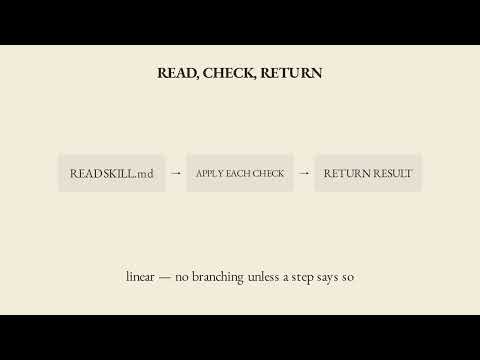
Inside the skill, a step section lays out a simple pipeline: read the situation, check it against a list of defined conditions, then answer. The important detail is what that middle step is not. It is not Claude weighing the situation on its own merits. It is Claude matching the situation against conditions someone already wrote down in advance. Once you see it that way, "is this a problem, according to Claude" really means "is this a problem, according to the checklist it was given."
Why this produces consistency
Feed the skill a situation the checklist anticipated, and it answers the same way every time. That reliability on repeat is the entire point of writing the criteria down instead of leaving them to case-by-case judgment. Same input, same output, every run, for as long as the situation matches something the checklist named.
Where the trade breaks down
Feed it something the checklist never named, and there is nothing to fall back on. The result is not wrong, exactly, it is simply outside what the spec covers. That is the trade a written checklist makes: consistency where it applies, silence everywhere else. A checklist-driven system will not quietly invent an answer for a case its author never anticipated, but it also will not flag that gap unless something in the design forces it to say so.
Turning your own gut calls into a checklist
The video's practical exercise is to take a decision you currently make by feel, whether something is urgent, whether it is worth escalating, whether it counts as a problem, and ask Claude to help write out the actual criteria behind that gut call as a short checklist. Then run your next three real cases through it and see what happens. The value is in watching two things: whether the checklist actually matches what you are really checking for, and whether it correctly flags the cases that do not fit rather than forcing an answer.
Key takeaways
- Claude's answer in a triage skill comes from matching the situation against a written checklist, not from independent judgment.
- The checklist lives in a single file, SKILL.md, in plain language with no hidden logic.
- Consistency is the payoff: the same input produces the same output every time the checklist covers it.
- The limit is equally real: anything the checklist never named gets no answer, not a wrong one.
- Writing your own gut-feel criteria into a checklist exposes both what you're really checking for and where your own rules have gaps.
Who this is for
Anyone building or relying on a Claude skill for triage, escalation, or any repeated judgment call, and anyone who wants to understand why a checklist-driven AI process behaves consistently in some cases and goes silent in others.
Full transcript(auto-generated, with timestamps)
[0:00]Someone assumes Claw judges. Is this a problem by feel? It doesn't decide, it checks. A written skill spells out exactly what counts as a problem. Liam walks you through it. A skill is a folder Claude reads before it acts. This one is called, "Is this a problem?" It's skill. MD holds the whole instruction set in plain language. No hidden logic. Nothing left to guess. Claude reads the file, then follows it. The file is the program. Inside a step section lays out the pipeline. Read the situation. Check it against a list of defined conditions. Then answer. Watch that middle step, the checklist. It isn't Claude weighing the
[0:34]Situation on its own. It's Claude matching it against conditions someone already wrote down. Back to that checklist. Feed it a situation the list anticipated and it answers the same way every time. Reliable on repeat. But feed it something the list never named and it has nothing to fall back on. Not wrong exactly, just outside what the spec covers. That's the trade a written checklist makes. Consistency where it applies. silence everywhere else. Is this a problem from Claude? Means, is this a problem according to the checklist it was given? Same input, same output every run. And only for what that checklist thought to name. Your turn.
[1:08]Here's the prompt. Read it with me. Pick one decision you currently make by gut feel. Is this urgent? Is this worth escalating? Is this a problem? Ask Claw to help you write out the actual criteria you're using as a short checklist. Then run your next three real cases through it and flag anything that doesn't fit. Lay them in for bear. Claude, is this a problem? Liam in for bear.