Claude, Hiring Review.
The hiring-review skill has Claude follow a single written checklist through a hiring decision step by step, which produces consistency but no independent judgment about who should be hired.
Claude picks up a skill called hiring-review. Does that mean it now has judgment about who to hire? No. A skill is a folder holding one file, SKILL.md, that Claude reads before it starts and then follows step by step, in the order written. Nothing about Claude's underlying capability changes; what changes is that it now has a checklist to follow.
Proof by deletion
Delete the skills folder and Claude loses no hiring judgment, because there was none to begin with. It just stops following that one checklist. That is the cleanest way to see what a skill like this actually is: a specification someone wrote down, not a new capacity for judgment that Claude acquired.
What's actually inside the file
Hiring-review is a folder holding a single SKILL.md file with instructions for walking through a hiring decision step by step, written in plain language Claude reads before it starts. Claude reads the file top to bottom and works through it in the order written, with no branching unless the file itself specifies one. That structure is what makes it a specification rather than judgment: the payoff is that the same checklist runs on every review, every time; the limit is that anything outside those written steps gets no special treatment or opinion from Claude.
What consistency actually buys you
Hiring-review never gives Claude judgment about who to hire. What it guarantees is that every time it runs, Claude reads the same file and follows the same checklist. That is the entire mechanism. The value is repeatability: the same categories get checked in the same order for every candidate reviewed, which removes the variability that comes from an ad hoc, case-by-case review process.
Why the outcome isn't proof either way
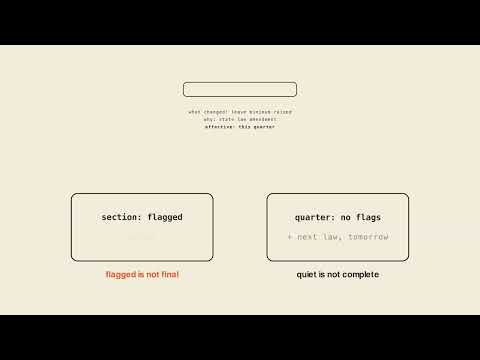
Watching Claude flag every risk in a hiring decision does not prove it understood the underlying situation. A checklist can be followed to the letter and still miss something it was never asked to check. Equally, watching it flag nothing does not prove the hire is clean; it may simply be a case the checklist doesn't cover. Neither a full report of flags nor a clean report is, on its own, evidence about the actual quality or risk of the hire. The checklist's coverage is the only thing being tested.
Writing your own version
The exercise the video offers is to pick one decision you check the same way every time, before an offer goes out, before a candidate advances to the next round, and write a SKILL.md for it: plain language, ordered steps. Then have Claude read it back and walk through exactly what it will check before checking it. Doing this on a decision you actually make repeatedly is the fastest way to see both what a written checklist captures and what it silently leaves out.
Key takeaways
- A skill named hiring-review does not give Claude hiring judgment; it is a checklist Claude reads and follows step by step.
- Deleting the skill folder removes no judgment, because none existed to begin with.
- The skill's value is consistency: the same steps, in the same order, on every review.
- Neither a fully flagged report nor a clean report is proof about the actual quality of a hiring decision; both only reflect what the checklist covers.
- Writing your own SKILL.md for a repeated decision exposes exactly what you check and what you might be leaving out.
Who this is for
Anyone using Claude for a repeated review process, hiring or otherwise, who wants to understand that a written skill provides consistency, not independent judgment, and wants a way to turn their own ad hoc review habits into a transparent checklist.
Chapters
- 0:00The naive framing: "Claude decides who gets hired"
- 0:09Sounds like hiring authority
- 0:18Broken, with a case — delete the folder, nothing is lost
- 0:28The anchor: one file — hiring-review's single SKILL.md
- 0:42Read it, then follow it in order
- 0:50Spec, not judgment — the payoff and the limit
- 1:01The anchor returns — same file, every run
- 1:13Both directions — neither one is proof
- 1:28Carry-out
- 1:40Your turn
- 1:55Outro
Full transcript(auto-generated, with timestamps)
The naive framing: "Claude decides who gets hired"
[0:00]You guess Claude decides who gets hired once it picks up a skill called hiring review. It doesn't. It follows a written checklist. Let's see what's actually inside that file.
Sounds like hiring authority
[0:09]Here Claude has a hiring review skill, and it sounds like Claude itself got hiring authority, like it can screen candidates and decide who moves forward.
Broken, with a case — delete the folder, nothing is lost
[0:18]But nothing in the model changes. Delete the skills folder and Claude doesn't lose any hiring judgment. There was none to begin with. It just stops following that one checklist. Here's what a skill
The anchor: one file — hiring-review's single SKILL.md
[0:28]Actually is, one file. Hiring review, for instance, is a folder holding a single skill, MD instructions for walking through a hiring decision step-by-step, written in plain language Claude reads before it starts. Claude reads that file top to bottom and works
Read it, then follow it in order
[0:44]Through it step-by-step in the order it's written, no branching unless the file itself says branch. That makes a
Spec, not judgment — the payoff and the limit
[0:50]Skill a specification, not new judgment. The payoff, the same checklist every review every time. The limit, anything outside those written steps and Claude has no special opinion about it. So
The anchor returns — same file, every run
[1:01]Hiring review never gave Claude judgment about who to hire. It just guarantees that every time hiring review runs, Claude reads that same file and follows the same checklist. That's the whole trick. Watching Claude flag every risk in a
Both directions — neither one is proof
[1:14]Hiring decision doesn't prove it understood the situation. A checklist can be followed to the letter and still miss what it was never asked to check. And watching it flag nothing doesn't prove the hire is clean. It may just be a case the checklist doesn't cover.
Carry-out
[1:28]A skill named hiring review doesn't hand Claude judgment about who to hire. It's a checklist Claude reads before it starts, so the same steps run every time, and anything outside those steps is still on you. Your turn. Paste this into Claude. Pick
Your turn
[1:41]One decision you check the same way every time before an offer goes out, before a candidate moves to the next round. Write me a skill MD for it, plain language ordered steps. Then read it back to me and walk me through exactly what you'll check before you check it.
Outro
[1:55]Claude hiring review, Liam Inforbear.