Claude, Case Brief.
A breakdown of Claude's case-brief skill showing a skill is a folder holding one instruction file that Claude reads and follows in order, not a new capability.
Claude's case-brief skill sounds like a legal upgrade, as if the model studied case law and came back knowing something new. It didn't. This video uses case-brief as a concrete example to show what a Claude skill actually is: a folder holding one file that Claude reads before it acts and follows in order.
The naive framing, and why it's wrong
The natural assumption is that a skill named "case-brief" means Claude picked up legal knowledge. Nothing in the model changes when a skill is added. Delete the skills folder and Claude doesn't forget any case law, because there was nothing to learn in the first place. It just stops following that one routine. That single test, delete the folder and see what's lost, is the clearest way to tell a skill from a capability.
What a skill actually is
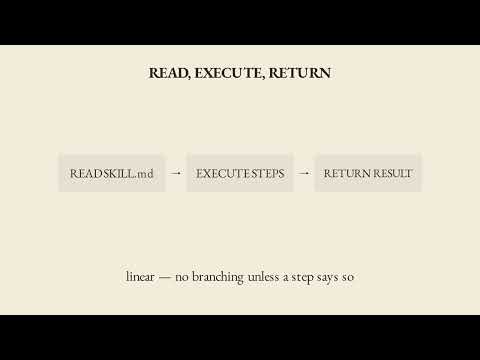
A skill is a folder holding a single file, SKILL.md, written in plain language. Case-brief's version holds instructions for turning case facts into a structured brief. Claude reads that file top to bottom before it starts, then works through it step by step in the order it's written. There's no branching unless the file itself calls for branching.
Spec, not power
That structure gives you a payoff and a limit at the same time. The payoff is consistency: the same brief structure every run, facts, issue, rule, conclusion. The limit is anything the file never wrote down. Case-brief never taught Claude how to read case law; it guarantees that every time the skill runs, Claude reads the same file and produces output with the same shape.
Why the output alone proves nothing
A clean brief doesn't prove Claude understood the case. The file can be followed to the letter on a case Claude never really grasped, because following steps and understanding content are different things. A messy brief doesn't prove the skill is broken either. It may just be a case the file's fixed structure doesn't fit well. Neither a good result nor a bad one is evidence of comprehension, only of whether the steps were followed.
Try it yourself
Pick one document you produce the same way every time. Ask Claude to write a SKILL.md for it in plain language with ordered steps, then have it read that file back to you and walk through exactly what it will do before doing it. Running this against a document you actually produce repeatedly is the fastest way to see the mechanism for yourself, outside of the legal example.
Key takeaways
- A Claude skill is a folder holding one file, SKILL.md, not a change to what the model knows.
- Deleting a skill's folder erases nothing Claude "learned," because skills don't add knowledge.
- Claude reads the file top to bottom and follows its steps in order, with no branching the file doesn't specify.
- The payoff of a skill is consistent structure every run; the limit is anything the file leaves unwritten.
- Neither a clean output nor a messy one proves the model understood the underlying material.
Who this is for
Anyone confused about whether adding a "skill" changes what Claude can reason about, and anyone who wants a template for turning a document they produce repeatedly into a written, ordered SKILL.md.
Chapters
- 0:00The naive framing: "Claude learned case law"
- 0:10Sounds like a legal upgrade
- 0:19Broken, with a case — delete the folder, nothing is forgotten
- 0:29The anchor: one file — case-brief's single SKILL.md
- 0:42Read it, then follow it in order
- 0:50Spec, not power — the payoff and the limit
- 1:02The anchor returns — same file, every run
- 1:13Both directions — neither one is proof
- 1:27Carry-out
- 1:36Your turn
- 1:49Outro
Full transcript(auto-generated, with timestamps)
The naive framing: "Claude learned case law"
[0:00]You guess Claude learned case law from a skill called case brief. It didn't. It was handed a file of instructions. Case brief just names one such file. Let's see what's actually inside it. Here
Sounds like a legal upgrade
[0:10]Claude has a case brief skill and it sounds like a legal upgrade, like it studied case law and came back knowing something it didn't before. But nothing in the model changes. Delete
Broken, with a case — delete the folder, nothing is forgotten
[0:20]The skills folder and Claude doesn't forget any case law. There was nothing to learn. It just stops following that one routine. Here's what a skill actually is, one
The anchor: one file — case-brief's single SKILL.md
[0:29]File. Case brief for instance is a folder holding a single skill, MD instructions for turning case facts into a structured brief, written in plain language Claude reads before it starts. Claude reads that file top to bottom and
Read it, then follow it in order
[0:43]Works through it step by step in the order it's written, no branching unless the file itself says branch. That makes a skill a specification, not a new
Spec, not power — the payoff and the limit
[0:51]Power. The payoff, the same structure every brief, facts, issue, rule, conclusion. The limit, anything outside those written steps and Claude is off the map. So case brief never taught Claude how to read case law. It just
The anchor returns — same file, every run
[1:04]Guarantees that every time case brief runs, Claude reads that same file and produces the same brief structure. That's the whole trick. Watching Claude produce a clean brief
Both directions — neither one is proof
[1:13]Doesn't prove it understood the case. A file can be followed to the letter on a case it never really grasped. And watching it produce a messy brief doesn't prove the skill is broken. It may just be a case the file's structure doesn't fit. A skill doesn't teach Claude how to read a case. It's a file
Carry-out
[1:28]Of steps Claude reads before it starts. So every brief comes out with the same structure every time. Your turn, paste this into Claude. Pick
Your turn
[1:36]One document I produce the same way every time. Write me a skill MD for it, plain language, ordered steps, then read it back to me and walk me through exactly what you'll do before you do it. Claude case brief lay them in forbear.