Bhavana's Week 07: Shown, Found, and Found Fast
Bhavana Bhariday explains the three levers that make job listing pages visible in search: getting shown, getting found by crawlers, and getting found fast.
Building a correct, well-structured page is only half the job. If Google never shows it, never finds it, or finds it too late to matter, all that correctness goes to waste. Week seven of this SEO engineering series tackles exactly that gap: the pages for a job listings site are built, and now the work shifts to making sure they actually get seen.
Three separate levers, three separate jobs
The framework here breaks visibility into three distinct problems, not one. For a page to get seen, it has to be shown in the search result, found by the crawler, and found fast enough that the information is still accurate by the time anyone sees it. Each lever solves a different piece of the puzzle, and each one has its own limit. Two of the three levers are already shipped in this project; the third is designed but not yet built.
Getting shown: FAQ structured data
The first lever is about earning better real estate in the search result itself. Every landing template now emits FAQ structured data, a block of questions each paired with its accepted answer. That structured shape is what allows Google to display an expandable question-and-answer panel directly in the search results, a kind of visibility a plain link can't earn on its own. But there's an important caveat worth holding onto: Google restricted FAQ rich results to authoritative health and government sites back in 2023, so on a job board this markup should be treated as a ceiling, not a guarantee.
Getting found: internal linking strategies
The second lever is about discovery. Every city page now links to nearby cities, every role page links to adjacent roles, and a directory ties the whole set of pages together. This matters for a quiet but important reason: crawlers mostly discover new pages by following links from pages they already know. A page with nothing pointing to it is much harder to find at all, no matter how well it's built. It's also worth noting that internal links do nothing for a page that's been set to noindex, so the linking strategy only helps pages that are actually eligible to be indexed in the first place.
Getting found fast: designing for indexing speed
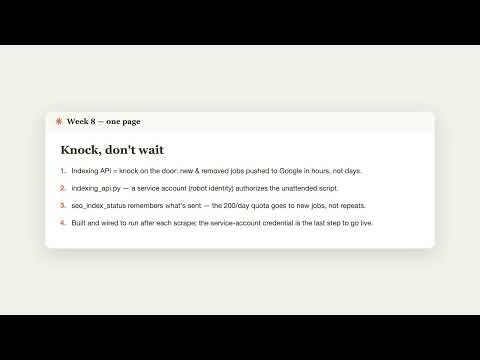
The third lever addresses a problem specific to job postings: they're time-sensitive in a way most content isn't. A filled listing shouldn't linger in search results, and a new listing should ideally be found within hours rather than whenever the crawler happens to circle back on its own schedule. This lever, built around the Google Indexing API for push indexing, is currently a design rather than a finished build. The open questions are what cadence to run it on, how to avoid resubmitting the same URL repeatedly, and how to signal to Google the moment a listing disappears. It's also worth noting that push indexing is wasted effort on evergreen pages that never change, it earns its keep specifically on fast-moving, time-sensitive content like job listings.
Key takeaways
- Visibility breaks into three separate levers: shown (how a page appears in results), found (whether crawlers discover it), and found fast (how quickly it's indexed).
- FAQ structured data can earn a richer search result, but Google has restricted this feature mostly to authoritative health and government sites since 2023.
- Internal links are how crawlers discover new pages; a page with no inbound links is much harder to find, though noindexed pages don't benefit from this at all.
- Push indexing through the Google Indexing API is best suited to time-sensitive content, like job postings, not evergreen pages that rarely change.
- A lever you can't actually apply to your situation is worse than no lever at all, each of these three has a specific case where it's the wrong tool.
Try it yourself
This walkthrough is part of the Humanitarians AI Fellows program, where fellows work through real technical projects like this SEO engineering series. If you have something you've built that's correct but quiet, try running the same three questions on it: is there structured data that would earn a richer result, does anything actually link to it, and if it changes often, how would you push updates instead of waiting to be crawled?
Chapters
Full transcript(auto-generated, with timestamps)
Three Levers on Visibility
[0:00]Hi, I'm Bavana, a humanitarian's AI fellow, week seven of my job seeker report, where I'm the SEO engineer making Google find and rank our job listings. The pages are built. This week is about getting them seen. Three levers on visibility, two shipped and one designed. Three levers, one framework
Shown: FAQ Structured Data
[0:20]Before the examples. For a page to get seen, it has to be shown in the result, found by the crawler and found fast enough to still be true. FAQ markup is shown. Internal links are found. Push indexing is found fast. Three separate levers and each one has a limit, which is exactly where we'll end up. First, getting shown. Every landing template now emits FAQ structured data. A FAQ page block, each question paired
Found: Internal Linking Strategies
[0:47]With its accepted answer. That's the structured shape Google can use to show an expandable question and answer panel where a page is eligible, real estate a plain link can't earn. Hold that word, eligible. We'll come back to it. Second, getting found. Each city page now links to nearby cities, each role page to adjacent roles, and the directory ties the whole family
Found Fast: Designing for Indexing Speed
[1:10]Together. This matters for a quiet reason. Crawlers discover new pages mostly by following links from pages they already know. A page with no links pointing to it is much harder to find at all. Third, getting found fast, and this one is just a design this week, not a build. Job postings are time sensitive in a way most content isn't. A filled listing shouldn't linger in search, and a new one should be found in hours, not whenever the crawler circles back. Waiting on Google's schedule isn't good enough. So, the questions are, what
Recap: Being Right is Not Enough
[1:41]Cadence to run on, how to avoid resubmitting the same URL over and over, and how to tell Google the moment a listing disappears. Now, the limits, because a lever you can't apply is worse than none. FAQ rich results, Google restricted these to authoritative health and government sites back in 2023. So, on a job board, treat the markup as a ceiling, not a guarantee. Internal links do nothing for a page you've set to noindex, and push indexing is wasted on evergreen pages that never change. Every lever has a case where it's the wrong tool. The recap: Shown, FAQ structured data earns an expandable answer panel in search. Found, internal links
Are how crawlers discover pages, so nothing sits as an island. Found fast, the indexing API is designed, but not yet built, to keep time-sensitive listings current. Two threads, one goal. The rule this week, being right isn't enough. A page still has to be shown, found, and found fast. Your turn. Take something you've built that's correct, but quiet, and ask Claude the visibility questions. Is there structured data that would earn it a richer result? Does anything actually link to it? And if it changes often, how would you push updates instead of waiting to be crawled? Run this, and find out if being right is enough. Shown, found, and found fast.